Space weather conditions
Live geomagnetic and solar activity data from NOAA's Space Weather Prediction Center (SWPC), fetched directly from swpc.noaa.gov in your browser. This page always shows current conditions — it is not part of the static county dataset and is not cached at build time.
Geomagnetic activity (planetary K-index)
The planetary K-index (Kp) measures disturbance of Earth's magnetic field on a 0–9 scale, estimated from ground magnetometers every minute. Kp 5 and above corresponds to NOAA's G1–G5 geomagnetic storm scale.
Solar X-ray flux
GOES satellites continuously measure solar X-ray flux. The long-wavelength (0.1–0.8 nm) channel is used to classify solar flares on the A–B–C–M–X scale, where each letter represents a tenfold increase in flux and M- or X-class flares can disrupt HF radio and GPS.
Source: NOAA SWPC GOES X-ray flux (primary satellite, 6-hour).
Aurora visibility forecast
NOAA's OVATION model produces a 30-minute forecast of aurora location and intensity for the northern hemisphere, updated continuously.
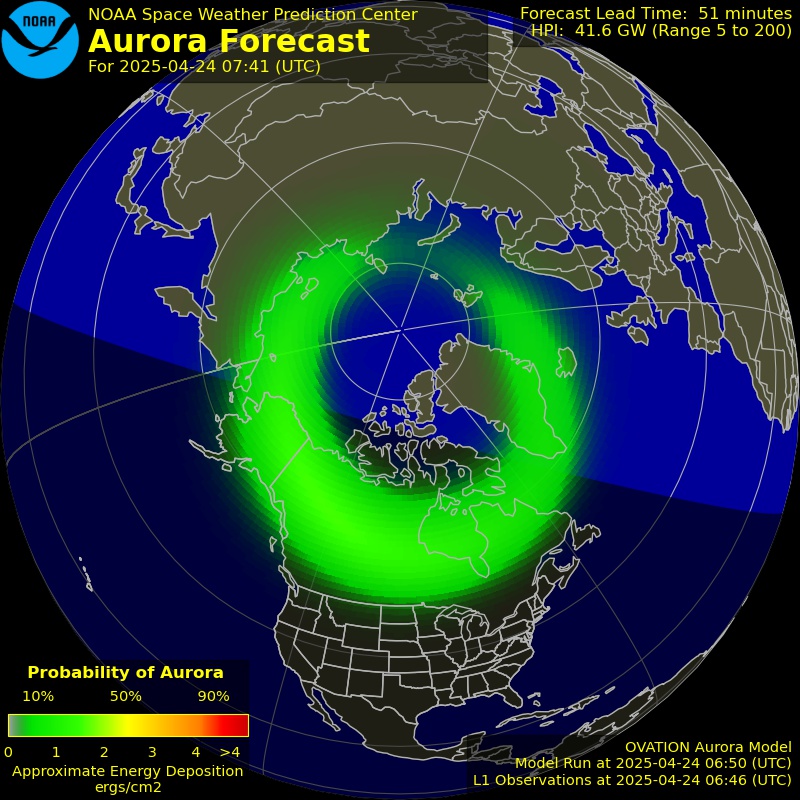
As a rough guide, here is how far south aurora typically becomes visible on the horizon under clear, dark skies at a given planetary K-index. "Geomagnetic latitude" is the same figure shown on each county's risk page — compare it to the threshold here to estimate when aurora might be visible from that county.
| Kp | NOAA scale | Geomagnetic latitude | Typical southern extent (continental US) |
|---|---|---|---|
| 5 | G1 – Minor | 56.3° | Northern Michigan, Maine |
| 6 | G2 – Moderate | 54.2° | New York, Idaho |
| 7 | G3 – Strong | 52.2° | Illinois, Oregon |
| 8 | G4 – Severe | 50.1° | Alabama, Northern California |
| 9 | G5 – Extreme | 48.1° | Florida, Southern Texas |
Sources: NOAA SWPC OVATION aurora forecast and NOAA's published aurora viewline guidance. Actual visibility also depends on local cloud cover, light pollution, and time of night.
Active space weather alerts
The five most recent space weather alerts, watches, and warnings issued by NOAA SWPC, covering geomagnetic storms, solar radiation storms, and radio blackouts.
Source: NOAA SWPC space weather alerts.